
What This Covers
Four things account for most of the calls.
Leak repair. Pinholes in supply lines, weeping fittings, a compression joint under a vanity, a valve that has been slowly wetting a floor joist for a year. In older Quincy and Dorchester buildings the leak is very often at a transition, the point where somebody joined newer pipe to original pipe, because that is where the metals and the workmanship change.
Faucet repair and replacement. Cartridges, stems, seats, aerators and the moment when a kitchen faucet is worth rebuilding versus replacing. In a two family or a three decker with three of everything, a faucet decision is often three faucet decisions.
Toilet repair and replacement. Running toilets, phantom refills, weak flushes, rocking bowls and failed wax seals. A toilet that runs every few minutes is quietly moving water through the meter all month, which is one of the few plumbing problems you can see on a bill before you see it on a floor.
Sink and fixture installation. Setting new fixtures, replacing supply stops and trap arms, and making the connections behind a vanity or a kitchen sink actually serviceable for the next person.
If the problem is water that will not drain rather than water that will not stop, that is drain cleaning and snaking. If the water is actively coming into the building right now, go straight to emergency plumbing and heating.
What a Plumbing Visit Looks Like
We start by looking, not by quoting. A running toilet can be a five dollar flapper or a failed fill valve or a cracked flush valve seat, and the only way to know is to take the lid off and watch it cycle. A leak under a sink can be the trap, the supply riser, the stop, or the faucet body draining down the tailpiece and pretending to be the trap.
Once we know what it is, we tell you what the repair involves and what it costs, and the price is agreed before work starts. There is no number you have not heard before a tool comes out. Credit cards are accepted.
When the work needs a permit, we pull it. Massachusetts requires a permit before plumbing is installed, altered, removed, replaced or repaired, with narrow exceptions that include repairing a leak in a faucet, a valve or a fixture’s working part, and clearing a stoppage. So rebuilding a faucet cartridge generally sits inside the exception, and replacing a run of pipe or setting a new fixture generally does not. In Quincy that permit goes to the Plumbing and Gas Department at 1305 Hancock Street and is filed online. Casper Plumbing & Heating is licensed, bonded and insured, and Massachusetts plumbing licenses are public record, so anyone can verify them on the state’s license lookup.
What Old Housing Stock Actually Does to the Plumbing
Nearly four in ten Quincy homes and roughly half of Boston’s were built in 1939 or earlier. That is not a decorative fact, it is a set of specific behaviors the crew plans around.
Pipe transitions are the weak points. A hundred year old building has almost never been repiped all at once. It has been repiped in sections, in whatever the going material was each decade. Every junction between two eras is a place where corrosion concentrates, and that is usually where the pinhole shows up.
Access is the hard part, not the fitting. In a Quincy three decker the supply runs climb through closets, chases and the back of kitchen cabinets. Reaching a leaking joint on the second floor sometimes means opening the first floor ceiling. We will tell you before we open anything, and we will tell you honestly which openings are necessary and which are optional.
Shut offs are old or absent. Fixture stops in pre war buildings seize. On a two family or three decker, a job that should isolate to one bathroom often means shutting the whole building down, which is a scheduling problem as much as a plumbing one. Where it makes sense, replacing a dead stop while we are already in there is the cheapest thing we will do that day.
Multifamily is the norm here, not the exception. In Quincy, 13.1% of housing units are in two unit buildings and another 9.2% are in three or four unit buildings. In Boston the three and four unit bracket alone is 22.8%. That means shared stacks, shared basements and repairs that affect somebody who is not the person who called. We plan around tenant access rather than treat it as a surprise.
MWRA water is consistent. Quincy is on MWRA supply, so when a fixture starts running badly the problem is almost always inside the building: a partly closed stop, a clogged aerator, a failing cartridge or a restricted supply line. Knowing that narrows the search on arrival.
Planned Work, Not Just Repairs
Plenty of this work does not need to be urgent. Replacing the original fixture stops in a unit before you rent it, swapping a faucet that has been rebuilt twice already, setting a new vanity and sink during a kitchen or bath refresh, or dealing with a leak you have been putting a bowl under since spring. Scheduled work is easier to price, easier to plan around tenants, and easier to get a permit and an inspection slot for.
If the same crew is already in the building for the heating side, it is worth mentioning that too. Casper does both trades, so a visit that starts as a leaking supply line and turns into a question about a cold radiator does not need a second contractor.
For more on the buildings we work in most, the neighborhoods, the permit process and what we see in Wollaston, Quincy Point, Merrymount and North Quincy, see the Quincy service area page. Call (617) 549-5734 to get on the schedule.
Gas, Bathrooms and Backflow
In Massachusetts a licensed master or journeyman plumber may carry on the work of a gas fitter, so gas line work is part of this trade rather than a separate contractor: running a line to a range or a dryer, extending piping for a kitchen change, and capping a line properly when an appliance comes out.
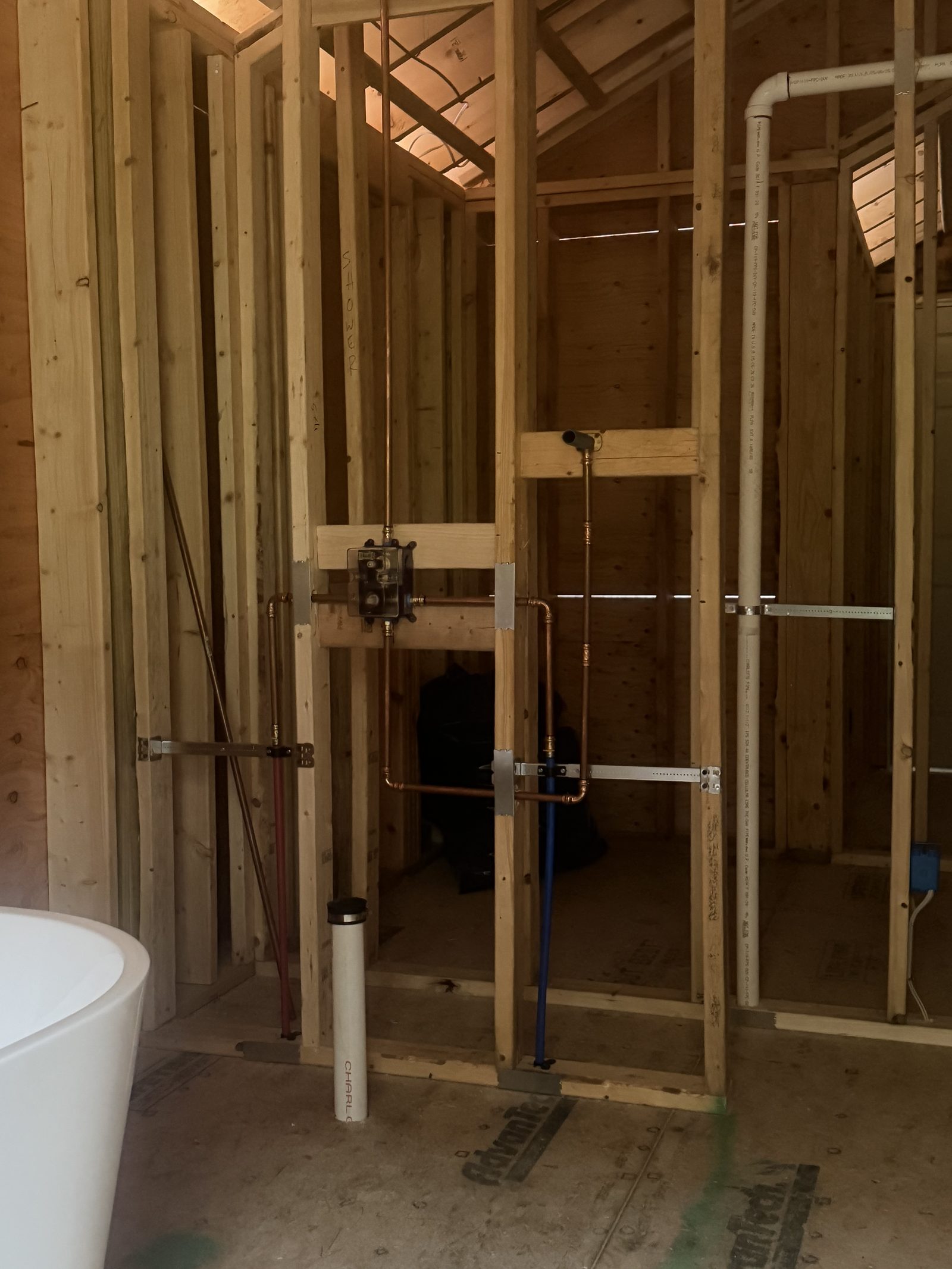
Bathroom plumbing covers the supply, the waste, the venting and the valves in a room that in most houses around here was installed long after the house was finished, which is exactly why what is behind the wall is rarely what anyone expects.
Backflow preventers are the devices that stop water traveling the wrong way when pressure in the main drops, and they turn up on irrigation connections, boiler fill lines and commercial equipment.
Sump pumps matter more here than inland, because a great many basements along this coast sit low relative to the water and everything else down there depends on the pump working. What usually fails is the float switch rather than the pump.
Repiping is the answer when galvanized supply has closed up from the inside, which it does invisibly over decades until pressure has quietly halved.
Garbage disposals covers units that hum, jam or leak, and the drain behind them that is often the real problem.
Water filtration covers treatment sized to what your water actually contains rather than to what is on the box.
Well pumps and water treatment serve the towns out west where most houses make their own water pressure rather than drawing it from a main.
Questions We Hear
How Do I Know If a Small Leak Is Worth Calling About?
If it is wetting wood, it is worth calling about. A drip into a bucket under a trap is cosmetic. A drip that lands on a joist, a subfloor or the top of a finished ceiling is doing slow damage you will not see until the plaster goes. The tell is a stain that changes shape over weeks, a musty smell in a closed cabinet, or a floor that feels soft near a fixture. Call (617) 549-5734 and describe where the water lands, not just where it starts.
My Toilet Runs Every Few Minutes. Is That a Real Problem?
Yes, and it is one of the few plumbing problems that shows up on a water bill before it shows up anywhere else. A toilet that cycles on its own is leaking past the flapper or the flush valve seat and refilling, all day and all night. Most of the time it is a straightforward repair to the parts inside the tank. Sometimes the tank hardware is worth replacing wholesale, especially on older units where parts are no longer matched. The toilet repair and replacement page covers the specifics.
Do You Need to Shut the Water Off to the Whole Building?
Sometimes, and in older buildings more often than anyone would like. If the fixture stop under the sink or behind the toilet still turns and still seals, we isolate there. In pre war Quincy and Dorchester buildings those stops have frequently seized, so the job goes back to the main in the basement. In a two or three family that affects every unit, so we will tell you in advance and coordinate with you on timing rather than knock on doors unannounced.
Do You Pull Permits for Plumbing Work?
Yes, when the work calls for one. Massachusetts requires a permit before plumbing is installed, altered, removed, replaced or repaired. The exceptions are narrow: repairing a leak in a faucet, a valve or a fixture’s working part, and clearing a stoppage. So a cartridge rebuild usually does not need a permit and a pipe replacement or a new fixture set usually does. In Quincy the permit goes through the Plumbing and Gas Department on Hancock Street and is filed online, and the inspection follows the work.
Can You Work Around Tenants in a Two or Three Family?
That is a large share of what we do here. Quincy and Dorchester are full of two, three and four unit buildings, and most repairs in them touch a stack or a basement that more than one household depends on. We work with the owner or the property manager on access and timing, tell you which units will lose water and for roughly what part of the day, and keep the work area contained. Landlords and managers can also see the commercial and multifamily page.
What If the Repair Turns Into Something Bigger?
We stop and talk to you. If we open a wall for a pinhole and find that the run behind it is the original piping and is going to keep failing, that is a different job with a different price, and you decide whether to do it now or schedule it. Nothing gets expanded without your say so. The emergency version of that conversation, where a burst pipe exposes a section that has to be dealt with immediately, works the same way, just faster.