Postwar Capes, Ranches and the Occasional Survivor
The median Braintree home was finished in 1957. About 28 percent of the town’s 15,163 housing units were built before 1940, and roughly another 27 percent went up between 1940 and 1959, so more than half of Braintree predates 1960. About 65 percent are single family detached and only around 9 percent sit in two to four unit buildings, which is a completely different mix from Quincy a few minutes north. Owner occupancy runs close to 78 percent.
That profile produces a recognizable set of calls. The 1950s cape with original copper that has started to weep at the elbows. The ranch whose cast iron waste line has given up at a hub joint under the slab edge of the basement. The tub and shower valve from an era when every manufacturer had its own stem, in a bathroom that has never been opened up. The finished basement family room added in 1978, put on its own heating zone, which is now the one room in the house that stays cold. A first generation replacement water heater from the 1990s sitting behind a paneled wall where nobody has looked at it in a decade.
Long tenure is part of the picture too. With nearly four in five homes owner occupied, a lot of Braintree systems have had exactly one or two owners, which means they were maintained consistently or not at all, with very little in between. Both of those are easy to work with once you know which one you have got.
Oil Heat Is Still a Braintree Story
About 31 percent of occupied homes in Braintree heat with fuel oil. That is a striking number for a town this close to Boston, and it is roughly two and a half times Quincy’s share. Utility gas covers about 51 percent, and electricity about 13 percent.
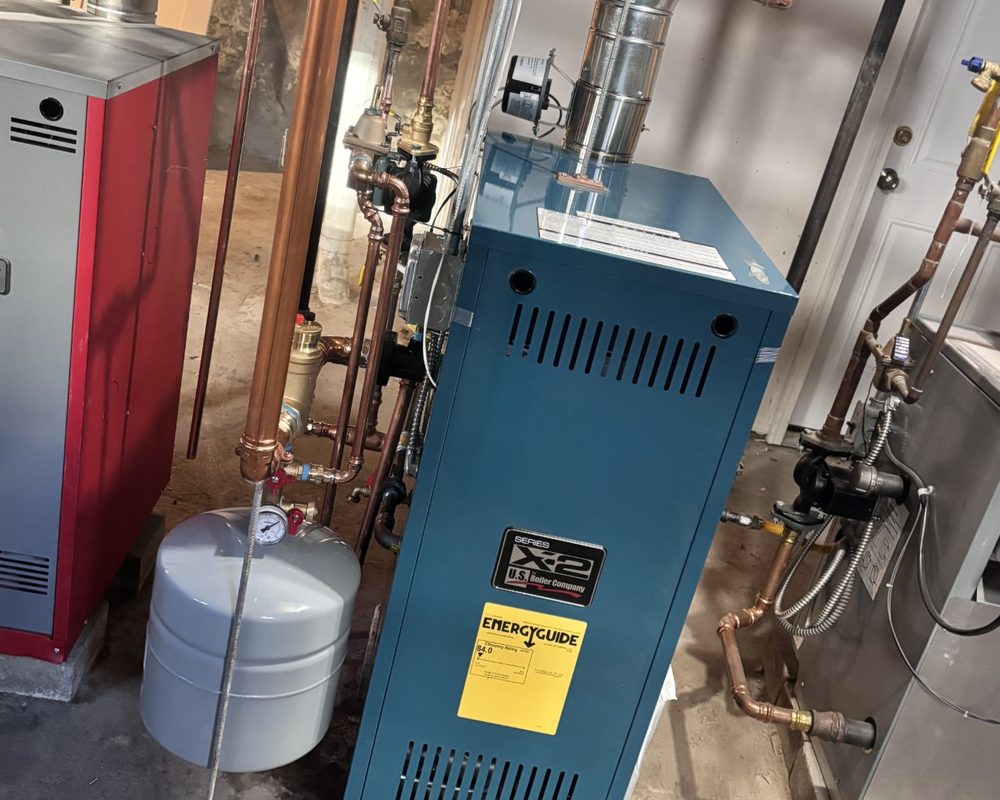
What that means on a cold morning is that a meaningful share of the no heat calls in this town start in a basement with a tank in it, and the failure points are not the same as in a gas fired house. Hot water distribution through baseboard and cast iron radiators is common, and so are the ordinary hydronic problems: a circulator running without moving water, a stuck zone valve, an air bound loop on the upper floor or over an unheated garage, a fill assembly nobody has touched since the system was installed.
The diagnostic order does not change with the fuel. Confirm there is a call for heat, confirm the system is trying to answer it, then work through fill, circulation and zoning before touching the distribution. Most of the Braintree houses we see with one cold room and a warm rest of the house have a circulation or zone control problem, not a dead heating plant. The no heat page sets out how we work through it. Heat in January is not a wait and see problem in a town where a lot of the piping runs through unheated crawl space, so calling (617) 549-5734 on the first cold night is better than on the third.
The Town Supplies Its Own Water and Its Own Power
Braintree is not an MWRA water community. The MWRA’s own customer community list does not show Braintree as a water customer. The town’s water comes from its own municipal supply and treatment, and the town tells residents to contact its own water department directly to start service.
Braintree’s electricity is the same story. The Braintree Electric Light Department, which everyone here calls BELD, is a municipal electric utility that supplies power to the town rather than an investor owned company. If you live here you already know this from the bill. What it means for us is practical: when a job involves an electrical service question, a panel that is at capacity, or a disconnect and reconnect around equipment, the utility side of that conversation goes to BELD, not to a regional call center. Plan for a town utility’s process rather than a large company’s app.
The water side shows up in ordinary ways too. Locally drawn and treated water has a different character than water delivered from the metropolitan system, and it interacts differently with the inside of a tank, with aerators and with valve seats. When we look at a Braintree water heater that has started to rumble on recovery or is delivering rust colored water at the hot tap, we are reading sediment and scale in that context. What gets checked, and in what order, is on the water heater page.
Neighborhoods and the Lay of the Town
Braintree does not have four tidy village centers, but it does have distinct sections, and the town names them itself: the Highlands, East Braintree, South Braintree Square, Dyer Hill and Granite Park among them. The commercial spine runs around South Shore Plaza and the Route 3 interchange, and the town’s conservation land at the Town Forest, Sunset Lake, Pond Meadow Park and the Cranberry Pond area breaks up the street grid in ways that matter when you are routing a day.
The sections differ in building stock more than in style. The Highlands and the streets built out in the 1950s and 1960s are capes, ranches and split levels on generous lots. East Braintree, running toward the Fore River and the Weymouth line, holds older and denser housing, including some of the two family stock that the town’s overall numbers barely show. The condominium complexes the town mentions in its own description are scattered rather than concentrated, and they bring association rules and shared shut offs into jobs that would be simple in a single family house.
Weymouth Landing sits right at the town line, which is one of the places where a job in one town and a job in the other genuinely land in the same afternoon. The Weymouth page covers what changes once you cross it.
Drains in a Single Family Town
With most of Braintree in single family houses, drain calls here look different from the stacked buildings north of the line. There is usually one kitchen, one or two baths and a laundry, all feeding a run that leaves through the basement wall. The failures are concentrated: kitchen lines that have narrowed with grease over thirty years, a laundry standpipe that overflows when a modern washer dumps its load faster than the old line can take it, a basement floor drain that has silted in and only reveals itself when something upstairs overflows, a second floor tub that drains slowly because the trap arm has filled with hair and soap.
We work these from the closest accessible access point to the problem and we clear the line rather than just the fixture, because a kitchen line that was slow once is going to be slow again. The scope inside the home, sinks, tubs, showers, toilets, laundry and floor drains, is on the drain service page.
For Your Home
Plumbing, drains, water heaters, heating and cooling in houses, three deckers and condos, which is the housing this area is actually made of.
See Residential ServicesFor Your Building
The same trades planned around a building that has to keep working while you fix it, and written down afterwards for whoever has to be told.
See Commercial Services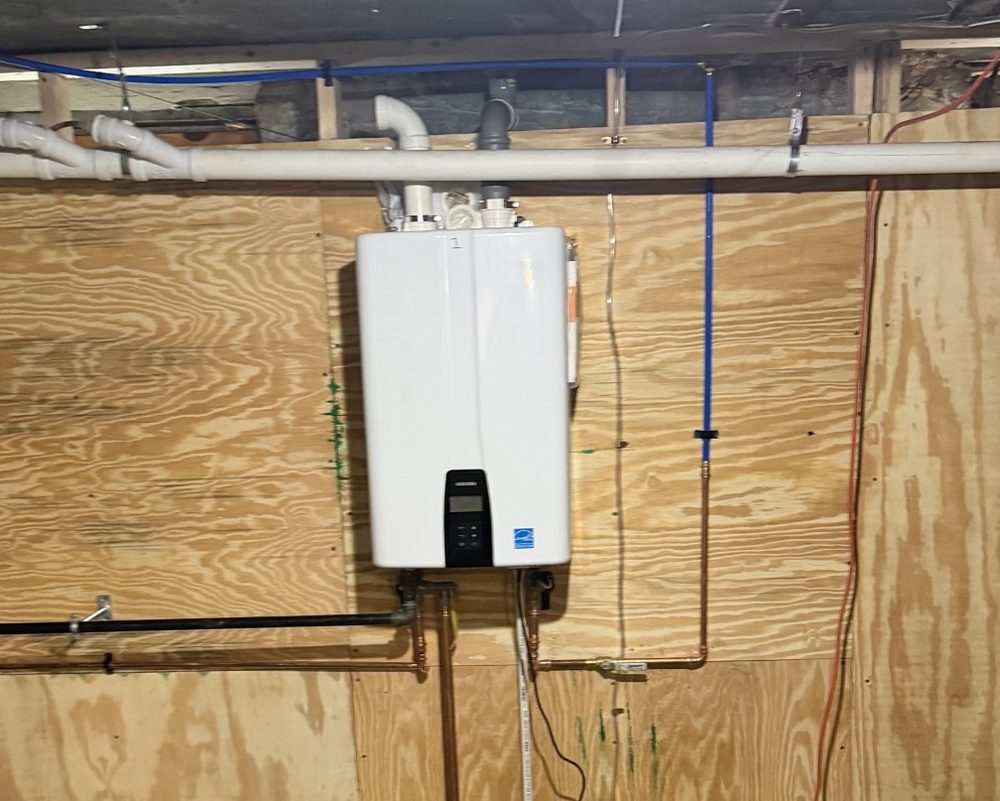
Three Deckers, Two Families and Old Boilers
Quincy and Dorchester are built out of three deckers, century old two families and apartment buildings that have been added to for decades. The plumbing and the heating in them grew up together, and a basement full of copper, cast iron and a boiler older than the people living upstairs is the ordinary day here.
That is the work Casper does. Licensed technicians and permits pulled where the work calls for them, on a kitchen sink in Milton, a no heat call from a landlord in Dorchester, or the water heater replacement in a Braintree storefront.
Permits in Braintree
Braintree handles permits and inspections through its Municipal Licenses and Inspection department, which includes the Building Division. A Massachusetts plumbing permit has to be taken out by a licensed plumber, and the inspection is scheduled against that permit and that license.
Casper Plumbing & Heating LLC holds Massachusetts Plumbing Corporation license 4667-PL-C, and Patrick Casper holds Master Plumber license 17118-PL-M. We pull our own permits and we meet our own inspectors. In a town where houses turn over after long single family tenures, permitted work is also the record that makes a sale go smoothly later.
What a Visit in Braintree Looks Like
You call (617) 549-5734 and tell us the address and what is happening. We ask what kind of house it is, roughly what year, where the shut off is if you know it, and what has been done to the system before.
On site we locate the shut off first, then work from source to symptom rather than starting at the complaint. We explain what we find in plain terms, and the price is agreed with you before any work begins. When something behind a wall turns out to be worse than the phone call suggested, you hear that in the basement, not on a bill.
Three miles is close enough that Braintree is part of the ordinary week here, not a trip we plan around. The rest of the towns are on the service area page.
Questions We Hear
Is Braintree on MWRA Water?
Not for drinking water. Braintree runs its own municipal water supply and treatment, and the town directs residents to its own water department to start service. The MWRA’s customer community list does not show Braintree as a water customer. That is a real difference from Quincy and Milton next door, which are on the metropolitan water system, and it is part of why sediment and scale behave the way they do in a Braintree water heater.
Who Is My Electric Utility in Braintree?
The Braintree Electric Light Department, BELD, which is the town’s own municipal electric utility rather than an investor owned company. For plumbing and heating work it matters when a job touches the electrical service: a panel at capacity, a disconnect around equipment, or a service question all go through BELD’s own process. It is worth knowing before a job is scheduled rather than on the day.
A Lot of My Street Still Heats With Oil. Is That Unusual?
Not in Braintree. About 31 percent of occupied homes here heat with fuel oil, which is high for a town three miles from Quincy and roughly two and a half times Quincy’s own share. Utility gas covers about half the town and electricity about 13 percent. Whatever the fuel, the hydronic side behaves the same, and most single cold room complaints here come down to circulation, a zone valve or air in a loop.
Why Is the Room Over My Garage Always Cold?
Because it was almost certainly added or finished later and put on a zone of its own, and that zone runs through the least insulated part of the house. In Braintree’s 1950s and 1960s stock that is a family room addition, a bonus room over a garage or a finished basement. The usual causes are an air bound loop, a zone valve that is not fully opening, or a circulator that no longer moves water well enough to reach the far end. We check those before anybody discusses larger work. The no heat page covers the order.
Who Issues Plumbing Permits in Braintree?
Braintree’s Municipal Licenses and Inspection department, through its Building Division. Massachusetts requires a licensed plumber to take out the permit, so it is not something a homeowner can file on their own behalf for work a contractor is doing. We apply under our own corporation and master plumber licenses and we meet the inspector on site.
Do You Work on Braintree Condominiums?
Yes. The town’s own description notes the several condominium complexes here, and they change how a job runs: a shut off may be shared, the association may control the riser or the heating plant, and a trustee frequently needs the scope in writing before anything is approved. Say on the first call that it is an association property and we will start with the right person rather than discovering the structure halfway through.