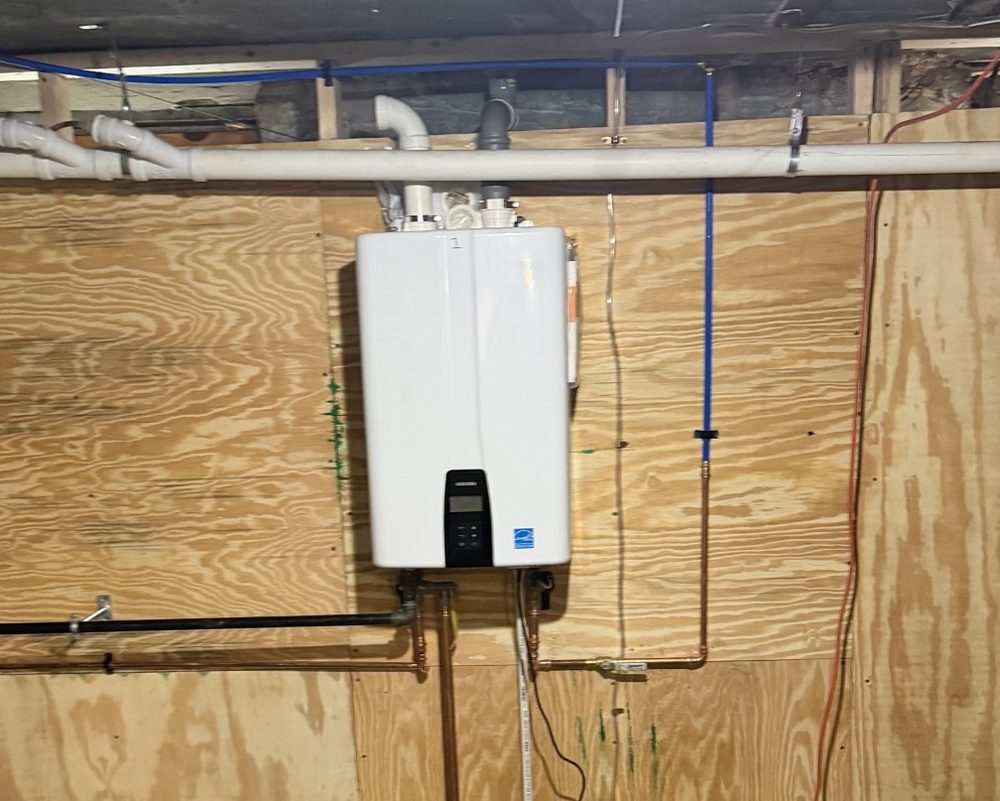
Repair, Replacement and Installation
Repair. Not every hot water complaint is a dead tank. Water that runs hot then cold, water that never gets hot enough, a tank that recovers too slowly for the household, a relief valve that is discharging, a fitting that is weeping at the top of the tank: these are separate problems with separate fixes, and several of them are repairs rather than replacements. We look before we recommend.
Replacement. When a tank is at the end of its life, the decision is not only which unit. It is what size the household actually needs, where the unit can physically go, what the connections and the shut offs look like, and how the old one comes out. In a Quincy three decker basement with a bulkhead and a low ceiling, that last question is a real part of the job.
Installation. New tanks in new locations, a unit relocated to free up a basement, or a fresh installation as part of a larger plumbing job. Installations are permitted work, and we pull the permit and see the inspection through.
If there is simply no hot water at all right now, that is the no hot water page. If the tank is leaking onto a floor as you read this, shut the water to it if you can reach the valve and call (617) 549-5734, because that is an emergency plumbing and heating call.
Signs a Tank Is Near the End
- Rusty or discolored hot water, especially when the cold runs clear. That is the inside of the tank talking.
- Popping, rumbling or kettling sounds during recovery, which usually means sediment has built up on the bottom of the tank and water is boiling under it.
- Recovery that keeps getting slower. Same household, same habits, less hot water each month.
- Moisture at the base, a rust ring on the floor, or a drip pan that is no longer dry.
- Discharge from the relief valve. Sometimes that is the valve. Sometimes it is telling you something about pressure or temperature that needs looking at.
- Age. A tank quietly past its expected service life in a finished basement is a flood waiting for a weekend away.
None of those means the tank has to be replaced today. All of them mean it is worth knowing where you stand before the decision gets made for you.
What Happens on the Visit
We start with the tank and its surroundings: age and size, the condition of the fittings, whether the shut offs still work, whether there is a drip pan and where it would drain, and how the unit is actually connected. Then we look at the complaint itself. A household that has outgrown its tank and a tank that has failed look identical from the shower, and they have completely different answers.
Then we talk. You get told what we found, what the repair or the replacement involves, and what it costs, and the price is agreed before any work starts. Credit cards are accepted. If a repair is the right call, we will say so. If the tank is past the point where a repair is a good use of your money, we will say that too, plainly, and tell you why.
Massachusetts requires a permit before plumbing is installed, altered, removed, replaced or repaired. Replacing or installing a water heater is permitted work. In Quincy that goes to the Plumbing and Gas Department at 1305 Hancock Street and is filed online. In Boston, the city is explicit that a water heater install or replacement needs a Plumbing Permit and that only a contractor with a valid Massachusetts trade license can apply for it, which is worth knowing if you own a Dorchester property. Casper Plumbing & Heating is licensed, bonded and insured, we pull the permit, and the inspection happens.

What Makes Local Water Heater Work Different
The basement is the constraint. Nearly four in ten Quincy homes and roughly half of Boston’s were built in 1939 or earlier, and those basements were not designed around modern equipment. Low headroom, a narrow bulkhead or a turning stair, a floor that is not level, and a mechanical corner already holding a boiler and a meter. We size and route the job around the space that actually exists, and we measure the way out before we commit to a unit coming in.
Multifamily changes the question. In Quincy, 13.1% of housing units are in two unit buildings and 9.2% are in three or four unit buildings. In Boston the three and four unit bracket alone is 22.8%. A building may have one tank per unit lined up along a basement wall, or one shared tank doing work it was never sized for. Those are different conversations, and if you own the building the right one to have is about the whole basement, not just the tank that failed.
Hot water is not optional in a rental. The Massachusetts sanitary code requires an owner to keep the water heating facilities in good operating condition and to supply hot water at not less than 110 degrees, in enough quantity and pressure for ordinary use of the fixtures. A failed tank in a tenanted unit is therefore a compliance problem on a clock, not just an inconvenience. Landlords and property managers can read more on the commercial and multifamily page.
MWRA water is steady. Quincy is an MWRA community, so supply pressure and quality are consistent. That means when hot water performance changes, the cause is almost always the tank, the connections or a valve inside the building, which narrows the diagnosis considerably.
When the Boiler Makes the Hot Water
In a lot of houses around here the hot water is not made by a tank at all. It is made by the heating system, either through an indirect tank the boiler heats or through a coil inside the boiler itself. Oil heated houses are where this is most common, and oil is a large share of the stock across our area: it runs from roughly a sixth of homes in the newer towns to nearly half in Norwell, on the Census American Community Survey 2020 to 2024 figures.
It matters because of how the failure presents. The hot water goes and the heat is still fine, so the instinct is to price a water heater, when what has actually happened sits inside the heating system. We check which arrangement a house has before anyone prices anything, because the answer changes the job completely.
It also changes what a heating replacement means. If the boiler makes the hot water, replacing the boiler is also a decision about hot water, and the two should be planned together rather than discovered halfway through.
Planning It Instead of Reacting to It
The best water heater job is a scheduled one. A planned replacement means the right unit rather than whatever is available that afternoon, a dry basement instead of a wet one, and a permit and inspection handled in normal order. If your tank is old and you have been waiting for a reason, the reason is that a scheduled swap costs you a morning and an unscheduled one can cost you a finished basement.
While we are in the mechanical room we will usually flag anything else worth knowing: a weeping valve that belongs in plumbing repair and installation, a supply line that is a candidate for leak repair, or something on the heating repair and service side, since the same crew handles both. The Quincy service area page covers the neighborhoods and buildings where we do most of this work.
Call (617) 549-5734.
The Pages Under This One
Water heater repair is worth reading before anyone prices a replacement, because a thermostat, an element or a valve is a part rather than a tank.
Water heater replacement covers what genuinely ends a tank, what to put back in its place, and why matching the label on the old one is not always the right answer. Commercial water heaters is written for a building rather than a house, where the downtime costs more than the repair does.
Heat pump water heaters are electric tanks that move heat out of the basement air instead of making it with an element.
Gas water heaters bring their own set of parts and their own requirement, which is that combustion products have to leave the building properly. Tankless units heat water as it passes rather than storing it, which suits some houses very well and others poorly, and that page is honest about which is which. They are a genuinely good answer in the right basement and a poor one in the wrong one, and that page is mostly about how to tell which you have.
If a tank is leaking right now, the leaking water heater page covers what to do before anyone arrives.
Questions We Hear
How Long Should a Water Heater Last?
Longer than most people expect and shorter than most people hope, and local conditions matter. A tank in a dry, temperate basement that has been left alone generally outlives one in a damp, cold corner of an old three decker. The more useful number is not the manufacture date on its own, it is the manufacture date alongside what the tank is actually doing now: recovery time, water clarity, noise during heating, and whether the base and fittings are dry. Tell us the age on the phone and we will tell you what to look at.
There Is Water Under My Tank. Is It the Tank?
Not always, and it is worth a minute of looking before you assume the worst. Water at the base can come from the tank itself, from a fitting or union at the top running down the shell, from a relief valve discharge line, or from condensation in a humid basement. Those are very different outcomes and only one of them means replacement. If the water is spreading rather than damp, shut the supply valve to the tank if you can reach it safely and call (617) 549-5734.
Can You Get an Old Tank Out of a Tight Basement?
Usually, and it is a normal part of the work in this area. Quincy and Dorchester three deckers have bulkheads, narrow turning stairs and low ceilings, and older basements often have a mechanical corner that has been built around over the years. We look at the route out before we settle on the unit going in, because a tank that will not fit through the only door is not a solution. If access genuinely is the obstacle, we will tell you what the options are before anything is ordered.
Do I Need a Permit to Replace a Water Heater?
Yes. Massachusetts requires a permit before plumbing is installed, altered, removed, replaced or repaired, and a water heater replacement is squarely inside that. Boston states plainly that installing or replacing a water heater requires a Plumbing Permit and that only a contractor holding a valid Massachusetts trade license may apply for it. In Quincy the permit is filed online with the Plumbing and Gas Department on Hancock Street. We pull the permit as part of the job and the inspection follows.
I Own a Two Family. Should Each Unit Have Its Own Tank?
It depends on how the building is metered, how the basement is laid out and what the tenancies look like, and it is a question worth answering deliberately rather than at the moment a tank fails. Separate tanks give each unit its own supply and its own accountability. A single correctly sized tank can be simpler to maintain. What does not work well is a tank sized for one household quietly serving three. If you own multifamily property, we can look at the whole basement rather than only the failed unit.
Will You Tell Me the Cost Before You Start?
Yes. We look at the tank, the space and the connections, tell you what the work involves, and agree the price with you before anything begins. That holds for a repair and for a replacement, and the permit and inspection are part of what we describe up front rather than a surprise afterward. Credit cards are accepted. If both a repair and a replacement are genuinely reasonable options for your situation, we will lay out both and let you decide.