What a Triple Decker Does to Plumbing
Everything in these buildings stacks. One kitchen sits directly over the next, one bathroom over the next, and all three floors feed a single vertical waste stack running down a chase to the basement. The supply mirrors it. The house shut off is usually at the front of the basement near the meter, and from there a small number of risers feed everybody.
The consequence is that a Dorchester drain problem is rarely where the complaint is. A third floor tenant reports a slow kitchen sink, and the actual restriction is grease and scale built up in the stack two floors below, which is about to show up as a backed up first floor tub. We start at the lowest accessible cleanout and work up, because clearing the branch alone in a stacked building is a temporary answer. The drain cleaning page covers how that is done and why we ask for basement access before touching anything upstairs. Kitchens, tubs, showers, toilets, laundry and basement floor drains inside the building are the scope.
The other consequence is that one repair touches three households. We would rather knock on all three doors before shutting water down than surprise somebody mid shower. If you are the owner and you do not live in the building, tell us that on the first call to (617) 549-5734 and we will work out access before the truck is on the street.
Heat in a Building From 1910
In these ZIP codes roughly 68 percent of occupied homes heat with utility gas, about 20 percent with electricity and around 7 percent with fuel oil. What the fuel figures do not tell you is the configuration, and the configuration is the interesting part in Dorchester.
Some triple deckers run one boiler for the whole building, which means one thermostat somewhere deciding how warm three households are, and a landlord paying for all of it. Some were split into three separate systems, frequently decades apart, so the basement holds three units of three different ages crowded around one chimney and one electrical panel. Many still distribute through cast iron radiators on hot water or steam, with piping that has been modified by every owner since the building went up.
Diagnosing no heat in that environment means tracing which zone actually feeds which apartment before anything else, and that is frequently not what the labels say. Air bound top floor radiators, a circulator that runs without moving water, a stuck zone valve on the one floor that is cold, a low water condition on the fill side: those are the common answers, and none of them is solved by looking at the thermostat. The no heat page walks through the order we work in.
There is a legal edge to this in Boston that does not exist for an owner occupied single family. Under the housing code Boston Inspectional Services enforces, an owner paying the utilities has to keep a rental at a minimum of 68 degrees from 7 a.m. to 11 p.m. during the heating season, which runs September 15 to June 15, and it may not fall below 64 degrees outside those hours. Hot water has to be delivered between 110 and 130 degrees. A cold apartment in January is not a wait and see problem for a Dorchester landlord, and neither is a water heater that cannot keep three units supplied.
BWSC Water and Old Supply Piping
Dorchester’s water service is billed and maintained by the Boston Water and Sewer Commission, which buys treated water from the MWRA and distributes it through the city. Boston is one of 51 MWRA member communities, and the water itself comes from the Quabbin and Wachusett reservoirs by gravity, treated at the Carroll plant in Marlborough.
What that means at a Dorchester address is that the city side of the connection is generally in better shape than the house side. In buildings of this age the oldest, narrowest pipe in the system is usually inside the wall. Galvanized supply that has been in service for eighty or ninety years closes up from the inside, and the first sign is a third floor shower that dies whenever a washing machine downstairs fills. The second sign is a pinhole.
That is the point at which to call rather than wait. In a three family, a slow leak inside a chase runs down through two other people’s ceilings before anyone sees it. Finding it without opening every plaster wall on the way is the whole skill, and the leak repair page covers how we go about it.
The Parts of Dorchester We Are In
Boston runs its neighborhood liaison coverage across Savin Hill, Ashmont, Lower Mills and Dorchester Bay on one side and Uphams Corner, Bowdoin Geneva, Four Corners and Codman Square on the other, and the city’s Main Streets districts include Fields Corner, Bowdoin Geneva, Four Corners, Grove Hall and Uphams Corner. Adams Village, Neponset and Port Norfolk fill in the Quincy end.
Those names are not decoration. The building stock changes as you move through them. Around Savin Hill and Uphams Corner the density and the age run highest, with a heavy concentration of three and four family structures and a lower owner occupancy rate. Out toward Ashmont, Adams Village, Lower Mills and Neponset there are more two families and more single family houses, more owner occupants, and more of the renovation work that comes with people staying put: a bathroom added where there was a closet, a kitchen moved, a basement finished around a boiler that was never meant to be enclosed.
Lower Mills is also where Dorchester and Milton run into each other across the Neponset. Milton was originally part of Dorchester and was set off as its own town in 1662, which is why the housing and the mill era street pattern on the two sides of the river have more in common with each other than either has with the rest of its own municipality. We work both sides; the Milton page covers what changes once you cross the water.
For Your Home
Plumbing, drains, water heaters, heating and cooling in houses, three deckers and condos, which is the housing this area is actually made of.
See Residential ServicesFor Your Building
The same trades planned around a building that has to keep working while you fix it, and written down afterwards for whoever has to be told.
See Commercial Services
Three Deckers, Two Families and Old Boilers
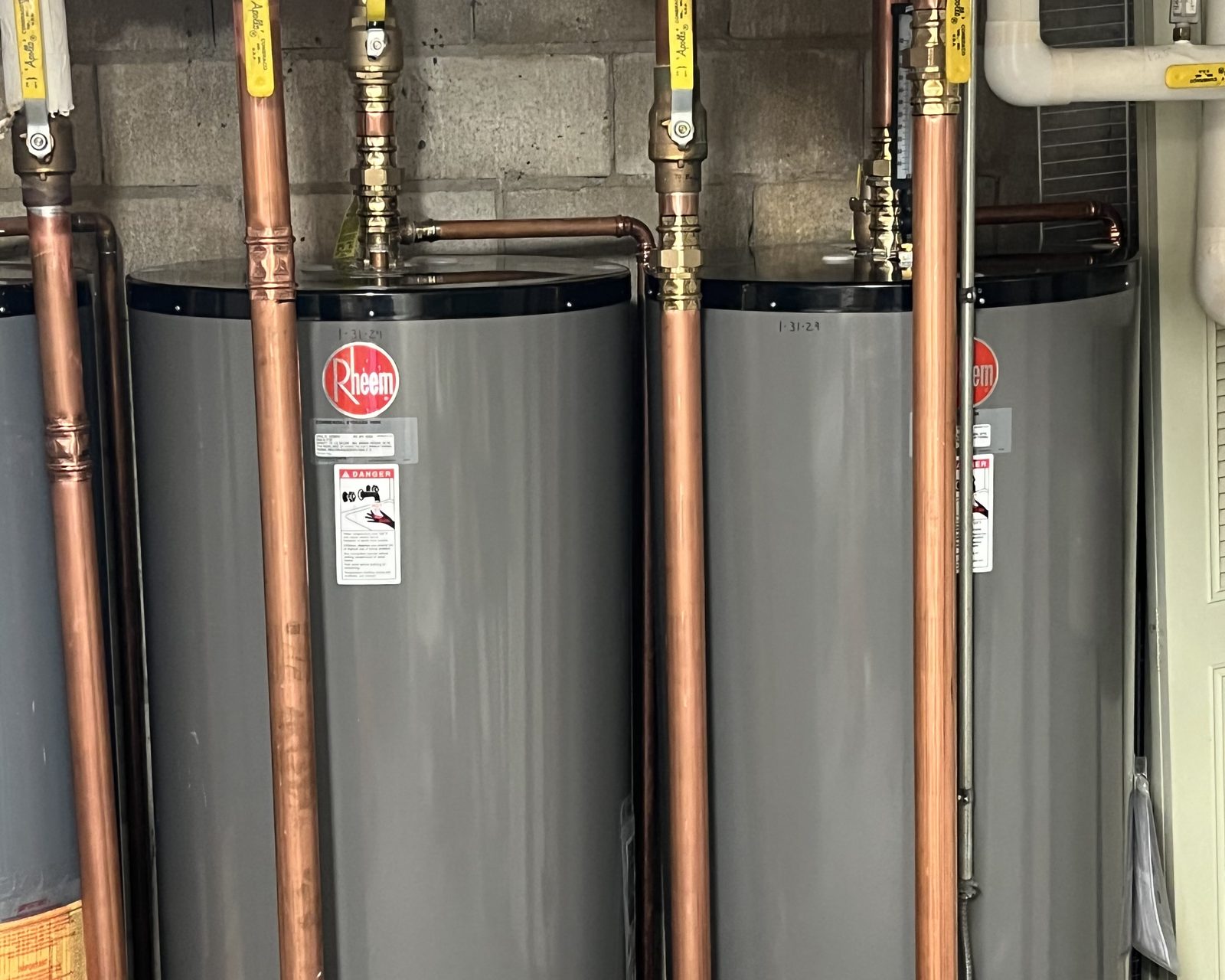
Quincy and Dorchester are built out of three deckers, century old two families and apartment buildings that have been added to for decades. The plumbing and the heating in them grew up together, and a basement full of copper, cast iron and a boiler older than the people living upstairs is the ordinary day here.
That is the work Casper does. Licensed technicians and permits pulled where the work calls for them, on a kitchen sink in Milton, a no heat call from a landlord in Dorchester, or the water heater replacement in a Braintree storefront.
Permits in Boston Are Different
Boston does not hand plumbing permits to just anyone. Inspectional Services issues them to licensed contractors only, the applicant has to be the contractor actually performing the work rather than an office clerk applying on their behalf, the trade license has to be current and match the applicant, and the licensed contractor has to be on site for the inspection. Applications go through the ISD online portal.
This trips people up in Dorchester more than in the suburbs, because the buildings change hands often and small jobs get done informally. Then a buyer’s inspection turns up unpermitted work in a three family and the sale stalls. Casper Plumbing & Heating LLC holds Massachusetts Plumbing Corporation license 4667-PL-C and Patrick Casper holds Master Plumber license 17118-PL-M. We take out our own permits in our own name and we meet the inspector ourselves, which is the only way Boston will do it anyway.
What a Visit in Dorchester Looks Like
Call (617) 549-5734 and describe the building as much as the problem: how many units, which floor, owner occupied or tenanted, and whether anyone else in the building has noticed the same thing. That last question saves more time in Dorchester than anywhere else we work.
We park where we will not block a shared driveway, we ask for the basement, and we start at the bottom of whichever system is failing. On a drain call that is the lowest cleanout. On heat it is the boiler, the fill and the zones. On a leak it is isolating and watching. We tell you what we find in plain language and agree the price before work begins. If the fix touches more than one unit, we say so before we start rather than after.
Dorchester is four and a half miles from the shop. We are not a Boston outfit passing through; we are the next city over, and we have been working these buildings from that side for years.
Questions We Hear
Why Is My Third Floor Sink Slow When Nobody Else Has a Problem Yet?
Because in a triple decker the three kitchens share one waste stack, and a restriction low in that stack shows up first at the fixture with the longest, slowest run to it. The third floor is the early warning; the first floor tub is usually next. We clear from the lowest accessible cleanout upward so the stack is actually open rather than just the branch you noticed. The drain page explains the method.
I Am a Landlord in Dorchester and a Tenant Says There Is No Heat. What Happens?
Boston’s housing code requires an owner paying the utilities to hold 68 degrees between 7 a.m. and 11 p.m. through the heating season, September 15 to June 15, and no lower than 64 degrees the rest of the time, with hot water between 110 and 130 degrees. So it is time sensitive. On the call we need to know whether the building runs one system or one per unit, which apartments are cold, and whether anything changed recently. Then we trace the zone that actually feeds that apartment, which in these buildings is often not the one labeled for it.
Where Does Dorchester’s Water Come From, and Who Do I Call About the Bill?
BWSC handles water service and billing for every Boston address, including Dorchester. It buys treated water from the MWRA, which draws from the Quabbin and Wachusett reservoirs and treats it at the Carroll plant in Marlborough before it reaches the city by gravity. Anything on the street side belongs to BWSC. Anything from your shut off inward is where we come in.
Do You Pull the Permit, or Do I?
We do, and in Boston it could not really work the other way. Inspectional Services issues plumbing permits to licensed contractors only, the application has to be in the name of the contractor doing the work, and that contractor has to be present for the inspection. We apply through the ISD portal under our own corporation license and our own master plumber license, and we meet the inspector.
My Triple Decker Has Three Old Boilers in One Basement. Is That Normal Here?
It is extremely common in Dorchester. Buildings that started with one central system were split unit by unit over the decades, often by different owners in different years, which is how three systems of three different ages end up sharing one chimney, one basement and one panel. It is workable, but it means diagnosis starts with mapping what feeds what. We do that first rather than assuming the previous owner’s labels are right.
How Far Into Boston Do You Actually Go?
Dorchester is our Boston limit right now, and we would rather tell you that plainly than take an address across town and show up late. The territory runs from the shop in Quincy through Dorchester on the Boston side, west to Milton, and south along the coast. The full list is on the service area page.